Subpart F – Inspection
§ 213.231 Scope
This subpart prescribes requirements for the frequency and manner of inspecting track to detect deviations from the standards prescribed in this part.
§ 213.233 Track inspections
233(a) All track shall be inspected in accordance with the schedule prescribed in paragraph (c) of this section by a person designated under §213.7.
Guidance. Recognizing that proper inspection of track is essential to safe maintenance, Subpart F contains the minimum requirements for the frequency and manner of inspecting track. Inspectors should know that a track owner may exceed the TSS in the interest of good practice, but they cannot be less restrictive. FRA’s track safety program success is dependent upon the adequacy of the railroad’s inspection efforts and subsequent maintenance program. Monitoring and assessing a railroad’s track condition, through regular inspections, is integral to our safety success.
233(b) Each inspection shall be made on foot or by riding over the track in a vehicle at a speed that allows the person making the inspection to visually inspect the track structure for compliance with this part. However, mechanical, electrical, and other track inspection devices may be used to supplement visual inspection. If a vehicle is used for visual inspection, the speed of the vehicle may not be more than 5 miles per hour when passing over track crossings and turnouts, otherwise, the inspection vehicle speed shall be at the sole discretion of the Inspector, based on track conditions and inspection requirements. When riding over the track in a vehicle, the inspection will be subject to the following conditions --
- (1) One Inspector in a vehicle may inspect up to two tracks at one time provided that the Inspector’s visibility remains unobstructed by any cause and that the second track is not centered more than 30 feet from the track upon which the Inspector is riding;
- (2) Two Inspectors in one vehicle may inspect up to four tracks at a time provided that the Inspectors’ visibility remains unobstructed by any cause and that each track being inspected is centered within 39 feet from the track upon which the Inspectors are riding;
- (3) Each main track is actually traversed by the vehicle or inspected on foot at least once every two weeks, and each siding is actually traversed by the vehicle or inspected on foot at least once every month. On high density commuter railroad lines where track time does not permit an on track vehicle inspection, and where track centers are 15 foot or less, the requirements of this paragraph (b)(3) will not apply; and
- (4) Track inspection records shall indicate which track(s) are traversed by the vehicle or inspected on foot as outlined in paragraph (b)(3) of this section.
Guidance. This paragraph specifies the number of additional tracks that can be inspected. Depending upon whether one or two qualified railroad inspectors are in the vehicle, and depending upon the distance between adjacent tracks (30 or 39 feet, measured between track centerlines), a track owner’s railroad inspectors may inspect multiple tracks (up to four) from hi-rail vehicles. Tracks obstructed from their view by tunnels, differences in ground level, railroad rolling stock, etc., cannot be included in the inspection record. Section 213.233(b)(3) requires each main track to be traversed at least once every 2 weeks, and a
siding traversed at least once every month. Track inspection records, under § 213.241, must indicate which tracks are traversed in accordance with paragraph (b)(3).233(c) Each track inspection shall be made in accordance with the following schedule:
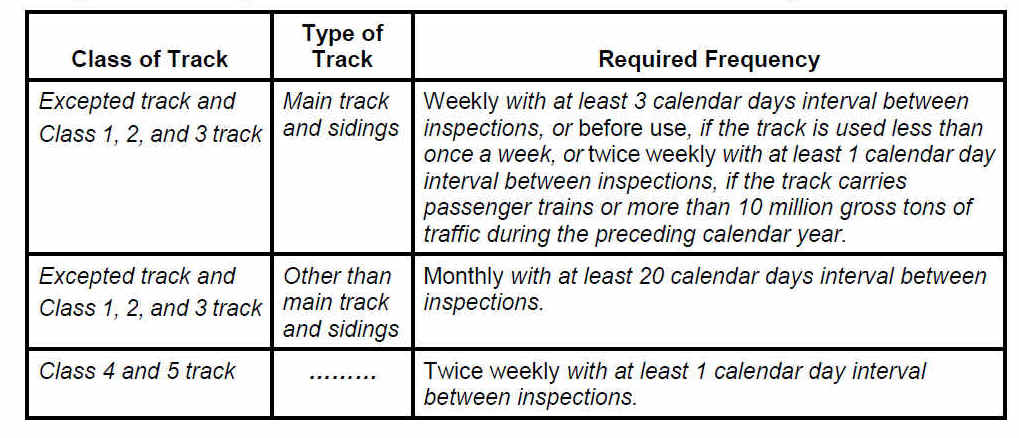
Guidance. A geometry car inspection will not be considered acceptable for meeting the required inspection frequency specified by § 213.233(c), unless a waiver allowing this substitution is in effect.
Section 213.233(c) specifies the minimum frequency at which inspections must be conducted. For purposes under § 213.233(c) and outlined in the frequency schedule, “main track” is defined as “a track, other than an auxiliary track, extending through yards and between stations.” A siding is defined as “an auxiliary track for meeting or passing trains.” Section 213.233(c) also links inspection frequencies to the amount of annual tonnage, presence of passenger trains, and speed according to track class. A railroad’s change in the designation of a track to “other than main track” in its timetable and/or special instructions may not necessarily permit a railroad to reduce track inspection frequency. If the traffic remains essentially the same, the station designations remain, or if the method of operations continue the same, the track will be considered a main track with respect to the TSS. In addition, if any main track type operating rules or procedures are applicable to a track in question, FRA will consider such a track as a main track under the TSS. This would be the case even if the railroad uses the term such as spur, lead, running, etc. to describe the track in question. (Source: Letter dated July 10, 1991, from FRA Associate Administrator for Safety to Union Pacific Railroad.)
Each railroad inspection performed in accordance with the schedule prescribed in paragraph (c) must be made on foot or by riding over the track in a vehicle at a speed that allows the person making the inspections to visually inspect the track structure for compliance. An inspection made from a vehicle driven alongside the track does not constitute an inspection performed at the required frequency. The railroad may make additional inspections using other inspection methods provided that these inspections are not used to comply with frequency requirements prescribed in Section 213.233.
Inspecting after dark is in compliance with the requirements of § 213.233, Track inspections, as long as the railroad inspector is capable of detecting defects. As an example, inspections are routinely made in tunnels with limited or no lighting, and maintenance requirements may require inspections after daylight hours. Appropriate artificial lighting is required for an inspector to conduct a valid inspection.
When FRA inspectors are conducting inspections from a hi-rail vehicle, only the track occupied will be recorded on the F 6180.96 form [hi-rail main track (MTH) or hi-rail yard track (YTH)]. When conducting a walking inspection, multiple tracks may be inspected and counted as units on the F6180.96 form. It is recognized that walking inspections reveal more defective conditions than hi-rail inspections. Therefore, FRA inspectors may include multiple tracks while conducting walking inspections. Inspectors will use good judgment in ensuring a high-quality inspection while conducting walking inspections.
For the purposes of the application of inspection intervals, a week is defined as a period of 7 days, Sunday through Saturday. This is the accepted standard definition and emphasized here to avoid confusion when the railroad changes the starting and ending days of a week from inspector to inspector or from territory to territory. Classes 1 through 3 track require a weekly inspection with at least 3 calendar days interval between inspections, or before use, if the track is used less than once a week; or twice weekly with at least 1 calendar-day interval between inspections, if the track carries passenger trains, or more than 10 million gross tons of traffic, during the preceding calendar year.
When a railroad operates seasonal or irregular passenger service, it is expected that the twice weekly inspection will be conducted during those periods. A railroad will be considered to be in compliance if the twice weekly inspection occurs the week before and the week or weeks that the passenger trains are operated. If a one time infrequent or seasonal passenger train movement occurs only on one day of a week, the twice weekly inspection the prior week and one [*] inspection the week of the movement is adequate.
[*] If the scheduled passenger train is to operate on one day only, at an interval during the week that does not allow for the two required inspections prior to that movement, then the one inspection for the week must occur before the movement.
233(d) If the person making the inspection finds a deviation from the requirements of this part, the Inspector shall immediately initiate remedial action.
Note: to §213.233. Except as provided in paragraph (b) of this section, no part of this section will in any way be construed to limit the Inspector’s discretion as it involves inspection speed and sight distance.
Guidance. To ensure that railroads are providing proper inspections at the required frequency, inspectors must periodically examine the railroad’s inspection records (noting record keeping type defects under § 213.241 only). By reviewing the track owner’s inspection procedures and records, or through personal observations, inspectors will determine the number of tracks being inspected, the number of railroad inspectors performing inspections, the specific tracks inspected, and whether the railroad inspector actually traversed the track by vehicle or on foot. As specified in this section of the TSS, the track owner must assure all tracks are inspected in accordance with the prescribed schedule. Failure of the owner to comply with this schedule may constitute a violation.
If a track owner’s qualified person, designated under § 213.7, finds a deviation from the TSS and fails to immediately initiate proper remedial action, the failure may constitute a violation. FRA track inspections do not constitute a required track inspection under the TSS. FRA inspections assess a railroad’s compliance with Part 213. Inspectors will review a track owner’s inspection records to learn if these records reflect the actual conditions of the track structure under train operations.
Turnouts and track crossings visually inspected from a vehicle must be accomplished at a speed not exceeding 5 mph. A vehicle’s speed will be at the sole discretion of the operator and is based upon track conditions, inspection requirements, operating rules, and other circumstances that may vary from day to day and location to location. Nothing in the TSS precludes an inspection from a train or engine as long as the overall effectiveness of the inspection is not compromised and the person is able to visually inspect the track structure for compliance with this part. However, examining track while simultaneously operating a locomotive shall not be considered as an inspection under the TSS. The person must have the ability to stop movements to make a close examination of any possible track defect.
Deviations found under § 213.233 are those observed in the field as opposed to the § 213.241 recordkeeping requirements, which are normally reviewed at a track owner’s corporate or division offices. Inspectors may also monitor other railroad records, such as a dispatcher’s or control operator’s record of track authorities conveyed and speed restrictions placed, to confirm that inspections were made and proper remedial actions were taken.
Classes 1 through 3 track require a weekly inspection with at least three calendar days interval between inspections, or before use, if the track is used less than once a week; or twice weekly with at least 1 calendar-day interval between inspections if the track carries passenger trains or more than 10 million gross tons of traffic during the preceding calendar year.
§ 213.234 Automated Inspection of Track Constructed with concrete Crossties
General Guidance
: This section —effective on July 1, 2012— requires the automated inspection of track constructed with concrete crossties. Automated inspection technology is available to perform essential tasks necessary to supplement visual inspection, quantify performance-based specifications to guarantee safe car behavior, and provide objective confidence and ensure safe train operations. Automated inspections also provide a level of safety superior to that of manual inspection methods by better analyzing overall weak points in track geometry and structural components. The computer systems in automated inspection systems can accurately detect geometry deviations from the Track Safety Standards and can analyze areas that are often hard to examine manually. Railroads benefit from automated inspection technology by having improved defect detection capabilities, suffering fewer track-related derailments, and improving overall track maintenance.Automated inspection technology is used in Track Geometry Measurement Systems (TGMS), Gage Restraint Measurement Systems (GRMS), and Vehicle/Track Interaction (VTI) performance measurement systems. TGMS identifies single or multiple noncompliant track geometry conditions. GRMS aids in locating good or poor performing track strength locations. VTI performance measurement systems indicate both acceleration and wheel forces that, when exceeding established thresholds, often cause damage to track components and rail equipment, as well as affect passenger ride quality. These automated systems can easily identify and measure track geometry, but they do not identify what causes them.
Automated technologies may be combined in the same or different geometry car platforms or vehicles, and require vehicle/track measurements to be made by truck frame accelerometers, car body accelerometers, or by instrumented wheel sets to measure wheel/rail forces, ensuring performance limits are not exceeded. Moreover, rail seat deterioration (RSD), can be very difficult and time consuming for inspectors to detect manually unless the rail and fastener assembly is removed. Automated inspection vehicles have proven effective in indicating RSD and can inspect much more rapidly and accurately than a visual track inspection. However, indications of RSD must be field-verified by inspectors taking accurate measurements to sustantiate the recorded measurement system.
(a) General. Except for track described in paragraph (c) of this section, the provisions in this section are applicable on and after July 1, 2012. In addition to the track inspection required under § 213.233, for Class 3 main track constructed with concrete crossties over which regularly scheduled passenger service trains operate, and for Class 4 and 5 main track constructed with concrete crossties, automated inspection technology shall be used as indicated in paragraph (b) of this section, as a supplement to visual inspection, by Class I railroads (including Amtrak), Class II railroads, other intercity passenger railroads, and commuter railroads or small governmental jurisdictions that serve populations greater than 50,000. Automated inspection shall identify and report exceptions to conditions described in § 213.109(d)(4).Guidance:
This paragraph specifies that automated inspection technology is to be used to supplement visual inspection by Class I railroads including Amtrak, Class II railroads, other intercity passenger railroads, and commuter railroads or small governmental jurisdictions that serve populations greater than 50,000, on track constructed of concrete crossties for Class 3 main track over which regularly scheduled passenger service trains operate, and for all Class 4 and 5 main track constructed with concrete crossties. Also, the rule requires that automated inspections identify and report concrete crosstie deterioration or abrasion prohibited by § 213.109(d)(4). The purpose of the automated inspection is to measure for RSD. As previously discussed, RSD is the failure of the concrete surface between the rail and crossties. § 213.109(d)(4) requires that the crosstie must not be "deteriorated or abraded at any point under the rail seat to a depth of ½ inch or more." The depth includes the loss of rail pad material.This paragraph explicitly states, that the requirements for automated track inspections do not become applicable until July 1, 2012.
Inspectors may use a step-gauge or caliper to verify the automated measurement of RSD and ensure proper rail seat depth compliance.
(b) Frequency of automated inspections. Automated inspections shall be conducted at the following frequencies:
- (1) If annual tonnage on Class 4 and 5 main track and Class 3 main track with regularly scheduled passenger service, exceeds 40 million gross tons (mgt) annually, at least twice each calendar year, with no less than 160 days between inspections.
- (2) If annual tonnage on Class 4 and 5 main track and Class 3 main track with regularly scheduled passenger service is equal to or less than 40 mgt annually, at least once each calendar year.
- (3) On Class 3, 4, and 5 main track with exclusively passenger service, either an automated inspection or walking inspection must be conducted once per calendar year.
- (4) Track not inspected in accordance with paragraph (b)(1) or (b)(2) of this section because of train operation interruption shall be reinspected within 45 days of the resumption of train operations by a walking or automated inspection. If this inspection is conducted as a walking inspection, the next inspection shall be an automated inspection as prescribed in this paragraph.
Guidance:
Frequency of automated inspections states the frequencies at which track constructed of concrete crossties shall be inspected by automated means. An automated inspection must be conducted twice each calendar year, with no less than 160 days between inspections, if the annual tonnage on Class 4 and 5 main track and Class 3 main track with regularly scheduled passenger service exceeds 40 million gross tons. An automated inspection must be conducted at least once each calendar year if annual tonnage on Class 4 and 5 main track and Class 3 track with regularly scheduled passenger service equals or is less than 40 mgt annually.Additionally, the regulation requires that either an automated or walking inspection be conducted once per calendar year on Class 3, 4 and 5 main track with exclusively passenger service. Track not inspected in accordance with paragraph (b)(1) or (b)(2) of this section because of train operation interruption must be reinspected within 45 days of the resumption of train operations by a walking or automated inspection. If this inspection is conducted as a walking inspection, the rule requires that the next scheduled inspection be an automated inspection. The rule provides sufficient flexibility to permit a track owner to schedule the inspections to allow for foreseeable operational conditions such as a standing train or failed equipment and still be able to conduct the required one or two inspections within a calendar year.
(c) Nonapplication. Sections of tangent track 600 feet or less constructed of concrete crossties, including, but not limited to, isolated track segments, experimental or test track segments, highway-rail crossings, and wayside detectors, are excluded from the requirements of this section.
Guidance: NONAPPLICATION excludes from the required automated inspections sections of tangent track of 600 feet or less constructed of concrete crossties, including, but not limited to, isolated track segments, experimental or test track segments, highway-rail crossings, and wayside detectors. These exclusions are specified because FRA recognizes the economic burden caused by requiring automated inspections to be made on short isolated locations constructed of concrete crossties that may be difficult to measure without removal of additional material, such as grade crossing planking.
(d) Performance standard for automated inspection measurement system. The automated inspection measurement system must be capable of indicating and processing rail seat deterioration requirements that specify the following:
- (1) An accuracy, to within 1/8 of an inch;
- (2) A distance-based sampling interval, which shall not exceed five feet; and
- (3) Calibration procedures and parameters assigned to the system, which assure that indicated and recorded values accurately represent rail seat deterioration.
Guidance: PERFORMANCE STANDARD FOR AUTOMATED INSPECTION MEASUREMENT SYSTEM requires that an automated inspection measurement system be capable of indicating and processing RSD requirements which specify the following: (1) an accuracy, to within 1/8 of an inch; (2) a distance-based sampling interval not exceeding five feet; and (3) calibration procedures and parameters assigned to the system, which assure that recorded values accurately represent RSD. RSD is indicated as a result of interpolations and calculations from rail cant measurements. The rail cant measurements provide an indication to the designated § 213.7 person that the location should be field-verified.
The design and practicality of all automated and autonomous geometry measurement systems is a supplement to visual inspection efforts toward identifying locations of greatest derailment risk. It is FRA’s objective and policy that on-the-ground visual verification must be done by inspectors to validate not only RSD, but also all track structure and geometry conditions discovered by automated means. While other automated inspection technologies may exist, the belief is FRA’s Rail Profile Measurement System (RPMS) is currently the best-developed technology to indicate (measure) RSD. The RPMS determines RSD by measuring rail cant angle in tenths of a degree. It is often difficult to measure rail cant in the field with hand measurement tools because of the small dimension, e.g., 1-degree rail cant angle equates to ⅛-inch depth between the rail seat and the rail. Typically the RPMS instrumentation onboard FRA geometry cars are set to notify an advisory ‘alarm’ exception when the angle exceeds 4 degrees of negative (outward) and positive (inward) rail cant.
FRA’s current fleet of automated inspection systems provides a reliable method of determining RSD. However, to allow for future advances in technology, FRA does not mandate that a track owner’s automated system ‘measure’ the rail cant angle to determine RSD. FRA also recognizes that detecting rail cant alone will not necessarily demonstrate all possible locations of RSD. For example, FRA geometry cars will not find areas of RSD that are due to compression forces from loads onto the crosstie. However, FRA geometry cars will locate RSD due to rail cant in curve and tangent track, which are the hardest areas to detect manually when the rail is obstructed.
(e) Exception reports to be produced by system; duty to field-verify exceptions. The automated inspection measurement system shall produce an exception report containing a systematic listing of all exceptions to § 213.109(d)(4), identified so that an appropriate person(s) designated as fully qualified under § 213.7 can field-verify each exception.
- (1) Exception reports must be provided to or be made available to all persons designated as fully qualified under § 213.7 and whose territories are subject to the requirements of § 213.234.
- (2) Each exception must be located and field verified no later than 48 hours after the automated inspection.
- (3) All field-verified exceptions are subject to all the requirements of this part.
- (4) Exception reports must note areas identified between ⅜ of and inch and ½ of an inch as an "alert."
Guidance: EXCEPTION REPORTS TO BE PRODUCED BY SYSTEM; DUTY TO FIELD-VERIFY EXCEPTIONS requires that the automated inspection measurement system produce an exception report containing a systematic listing of all exceptions to § 213.109(d)(4), identified so that appropriate persons designated as fully qualified under § 213.7, either a supervisor under § 213.7(a) or a track inspector under § 213.7(b), can field-verify each exception. A designated qualified inspector must receive any noncompliant rail seat deterioration reports, whether the reports are made accessible to or are physically handed to the person designated under § 213.7, for field verification and repairs purposes. This paragraph also requires that each exception be located and field-verified no later than 48 hours after the automated inspection, and that all field-verified exceptions are subject to all the requirements of Part 213. Inspectors should ensure that exceptions between three-eighths of an inch and one-half of an inch are reported as an ‘alert.’ Automated inspection exceptions equal to or greater than one-half inch would require field-verification by a qualified person under § 213.7. This is not only to ensure that the exception report accurately reflects the conditions of the track, but also to ensure that a qualified person can take appropriate remedial action in a timely manner.
(f) Recordkeeping requirements. The track owner shall maintain and make available to FRA a record of the inspection data and the exception record for the track inspected in accordance with this paragraph for a minimum of two years. The exception reports must include the following:
- (1) Date and location of limits of the inspection;
- (2) Type and location of each exception;
- (3) Results of field verification; and
- (4) Remedial action if required.
Guidance: RECORDKEEPING REQUIREMENTS contains a requirement that the track owner maintain a record of the inspection data and the exception record for the track inspected in accordance with this section for a minimum of 2 years. The record must include the date and location of limits for the inspection, type and location of each exception, the results of field verification, and any remedial action if required. The location identification must be provided either by milepost or by some other objective means, such as by the location description provided by the Global Positioning System. This new regulation is intended to require the track owner to keep a good record of the conditions of track constructed of concrete crossties and, through such records, FRA track inspectors will have a greater ability to gain access to and accurately assess the railroad’s compliance history.
(g) Procedures for integrity of data. The track owner shall institute the necessary procedures for maintaining the integrity of the data collected by the measurement system. At a minimum, the track owner shall do the following:
- (1) Maintain and make available to FRA documented calibration procedures of the measurement system that at a minimum, specify an instrument verification procedure that ensures correlation between measurements made on the ground and those recorded by the instrumentation; and
- (2) Maintain each instrument used for determining compliance with this section such that it accurately provides an indication of the depth of rail seat deterioration in accordance with paragraph (d)(1) of this section.
Guidance: PROCEDURES FOR INTEGRITY OF DATA requires that the track owner institute the necessary procedures for maintaining the integrity of the data collected by the measurement system. The track owner must maintain and make available to FRA documented calibration procedures of the measurement system that, at a minimum, specifies an instrument verification procedure that will ensure correlation between measurements made on the ground and those recorded by the instrumentation. Also, the track owner must maintain each instrument used for determining compliance with this section. The purpose of this paragraph is to ensure that the equipment that the track owner is using to comply with the regulations accurately detects what it is designed to detect. In lieu of rail cant angle reference, track owners can use alternative means of technology in their automated inspections to indicate RSD.
(h) Training. The track owner shall provide annual training in handling rail seat deterioration exceptions to all persons designated as fully qualified under § 213.7 and whose territories are subject to the requirements of § 213.234. At a minimum, the training shall address the following:
- (1) Interpretation and handling of the exception reports generated by the automated inspection measurement system;
- (2) Locating and verifying exceptions in the field and required remedial action; and
- (3) Recordkeeping requirements.
Guidance:
TRAINING requires that the track owner provide annual training in handling RSD exceptions to all persons designated as fully qualified under § 213.7 and whose territories are subject to the requirements of § 213.234. At a minimum, the annual training required by this paragraph shall address interpretation and handling of the exception reports generated by the automated inspection measurement system, locating and verifying exceptions in the field and required remedial action, and recordkeeping requirements. The objective is to ensure that all persons required to comply with the regulations are properly trained.§ 213.235 Inspection of switches, track crossings, and lift rail assemblies or other transition devices on moveable bridges
235(a) Except as provided in paragraph (c) of this section, each switch, turnout, track crossing, and moveable bridge lift rail assembly of other transition device shall be inspected on foot at least monthly.
Guidance. Paragraph (a) prescribes the frequency and method of inspection for switches, turnouts, track crossings, and moveable bridge lift rail assemblies or other transition devices by a track owner’s qualified persons. By examining records and conducting field investigations, FRA inspectors can confirm the track owner’s on foot inspection of each switch, turnout, track crossing, and moveable lift bridge rail assembly at least monthly.
235(b) Each switch in Classes 3 through 5 track that is held in position only by the operating mechanism and one connecting rod shall be operated to all of its positions during one inspection in every three month period.
Guidance. Each switch, in Classes 3 through 5 track, that is held in normal or reverse position by only one connecting rod is required to be operated (thrown) in all its positions during one track inspection by the track owner in every 3-month period. An example of a switch that has more than one connecting rod is a switch that also has a lock rod. A rod connecting a switch to a switch circuit controller (point detector) is not considered to be a rod that holds a switch in position. This requirement is designed to emphasize the importance of these nonredundant mechanisms. Thorough inspection is best accomplished by operating the switch mechanism to allow for a comprehensive inspection of these components. inspectors should observe the various switch components, determine their functional design, and assess missing components that are integral to safe operation. If the proper operation of the points is in doubt, inspectors should use the appropriate codes under § 213.133. The phrase “all positions” is intended to cover slip and lap (three-way) switches.
235(c) In the case of track that is used less than once a month, each switch, turnout, track crossing, and moveable bridge lift rail assembly or other transition device shall be inspected on foot before it is used.
Guidance. “Lift rails” have unique properties and functions. This discussion will focus on cast manganese alloy types of lift rail assemblies that provide a transition between a fixed span and a movable span on lift bridges, swing bridges, and bascules. Lift rails are made of three pieces for swing bridges: a section on the fixed span, a section on the movable span, and the rocker.
Analogous to a rail in some respects, a manganese lift rail
provides a running surface and it is also similar to a rail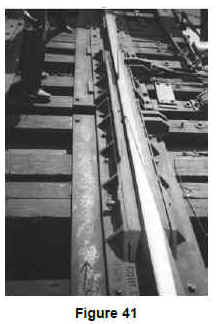 joint in that it
joins rails at the ends of bridge spans. It is made of manganese alloy, and it
has the appearance of a frog.
joint in that it
joins rails at the ends of bridge spans. It is made of manganese alloy, and it
has the appearance of a frog.
Manganese lift rails have tapered sections to reduce shock. The design provides for the transfer of wheels to take place on one span, rather than between spans. Track and bridge maintenance personnel familiar with manganese steel lift rails point out that cracks generally progress slowly.
Railroad maintenance officials advocate proper maintenance to prevent or reduce cracking of manganese lift rails. Because there is deformation of manganese over time, they recommend that metal flow be ground at the wheel contact point to reduce or prevent cracks. Railroad maintenance personnel also emphasize that the bridge itself can aggravate wear and deterioration of manganese steel lift rails when the bridge needs to be adjusted or repaired. The condition of the bridge ties, for example, is an important factor in the maintenance of these of such assemblies.
Policies regarding speeds on manganese lift rails are set by each railroad. Some railroads require a 25 mph maximum speed on all lift rails regardless of condition. Further reductions of train speeds should be placed when the lift rails deteriorate to prohibitive levels. In deciding to place a speed restriction or remove a lift rail from service, railroads consider a wide range of factors including the amount of traffic, bridge condition, and the condition of the lift rail itself.
In summary:
•
When evaluating the safety of a manganese lift rail assembly, inspectors must consider that cracks in manganese casting are known to propagate slowly. Although cracks are known to propagate slowly, they can be more hazardous under certain bridge conditions, such as a deteriorated deck. Inspectors are cautioned against citing § 213.113 (Defective rails) to describe cracks in the manganese casting running surface of the manganese lift rail appliance.•
Specific concerns about the safety of a manganese steel lift rails must be immediately brought to the attention of an appropriate railroad manager and discussed with the regional track specialist.General Guidance: Inspections conducted from a vehicle are not considered sufficient to determine compliance. Therefore, each switch; turnout; track crossing; and lift rail assembly, or other transition device on moveable bridges, will be inspected by a walking inspection before FRA inspectors can consider a unit (activity) inspected, as outlined in Chapter 2 of this manual.

§ 213.237 Inspection of rail
237(a) In addition to the track inspections required by §213.233, a continuous search for internal defects shall be made of all rail in Classes 4 through 5 track, and Class 3 track over which passenger trains operate, at least once every 40 million gross tons (mgt) or once a year, whichever interval is shorter. On Class 3 track over which passenger trains do not operate such a search shall be made at least once every 30 mgt or once a year, whichever interval is longer. This paragraph (a) is effective January 1, 1999.
Guidance: The inspection frequency requirements stated in this paragraph consider both the passage of time and the accumulated tonnage since the last inspection. Several methods are employed by railroads to estimate tonnage, but they are only estimates and cannot be considered as precisely accurate. In addition, scheduling of rail detection cars is influenced by many factors such as the availability of equipment if the service is contracted, equipment failures or various other scheduling problems, which may arise.
For Class 3 track, over which only freight operations are conducted, the date of the most recent inspection will define the beginning of a new inspection cycle, and before the expiration of time or tonnage limits, whichever is longer, an inspection for internal rail defects must be conducted. For Classes 4 and 5 track, and Class 3 track over which passenger trains operate, the date of the most recent inspection will define the beginning of a new inspection cycle, and before the expiration of time or tonnage limits, whichever is shorter, an inspection for internal rail defects must be conducted.
Language in § 213.237(a) refers to § 213.233 (Track inspection) indicating that many rail, defects, as well as conditions caused by wear or damage, cannot be visually discovered. These require an internal search by a detector car or other specialized detection equipment.
Some railroads have elected to perform more internal rail inspections than required under the TSS, with intervals between tests typically ranging from 20 to 30 million gross tons or between 20 and 30 days. These typical intervals define a good baseline for generally accepted maintenance practices, and the industry’s rail quality managers consider these limits as points of departure for adjustment of test schedules to account for the effects of specific track characteristics, maintenance, traffic, and weather.
The annual test requirement for Classes 4 and 5 track and Class 3 track over which passenger trains operate is based on risk factors associated with freight train speeds and passenger train operations.
Selecting an appropriate frequency of rail testing is a complex task involving many different factors which include, but are not limited to, temperature differential, curvature, residual stresses, rail sections, cumulative tonnage, and past rail test results. Taking into consideration all of the above factors, FRA’s research suggests that 40 million gross tons is the maximum tonnage that should be hauled between rail tests and still allow a safe window of opportunity for detection of an internal rail flaw before it propagates in size to a service failure. Furthermore, FRA’s Accident/Incident data points to a need for inclusion of all Class 3 trackage in a railroad’s rail testing program. The requirement states that Class 3 track, over which passenger trains do not operate, should be tested once a year or once every 30 million gross tons, whichever is longer.
Inspection equipment shall be capable of detecting defects between joint bars, in the area enclosed by joint bars.Guidance: The equipment used must be capable of detecting defects in the joint area as well as in the body of the rail. Two separate systems may be used to meet this requirement provided that each is used before the expiration of the time or tonnage limits as required by this section.
Each defective rail shall be marked with a highly visible marking on both sides of the web and base.Guidance: Each defective rail must be marked with a highly visible marking on both sides of the web and base to prevent reuse of the rail. A defect’s identity and control numbers are not required on the web and base, but may be used by a railroad for inventory purposes. Inspectors should be aware that rail with certain defects, such as a bolt hole crack, may have the defective portion "cropped" and the remaining portion placed back in service. The track owner may remove defect markings from the nondefective portion of such rail.
If the person assigned to operate the rail defect detection equipment being used determines that, due to rail surface conditions, a valid search for internal defects could not be made over a particular length of track, the test on that particular length of track cannot be considered as a search for internal defects under §213.237(a). ** (This paragraph (d) is not retroactive to tests performed prior to September 21, 1998).Guidance: This paragraph and paragraph (e) address a situation where a valid search for internal rail defects could not be made because of rail surface conditions. Several types of technologies are presently employed to continuously search for internal rail defects, some with varying means of displaying and monitoring search signals. A continuous search is intended to mean an uninterrupted search by whatever technology is being used, so that there are no segments of rail that are not tested. If the test is interrupted (e.g., as a result of rail surface conditions that inhibit the transmission or return of the signal) then the test over that segment of rail is not valid because it was not continuous. Therefore, a non-test is not defined in absolute technical terms. Rather, the provision leaves this determination to the rail test equipment operator who is uniquely qualified on that equipment. Paragraph (d) is not retroactive to tests performed prior to September 21, 1998.
If a valid search for internal defects cannot be conducted for reasons described in paragraph (d) of this section, the track owner shall, before the expiration of time or tonnage limits;- (1) Conduct a valid search for internal defects; Track and Rail and Infrastructure Integrity Compliance Manual Volume II, Chapter 1 – January 2014 2.1.142
- (2) Reduce operating speed to a maximum of 25 miles per hour until such time as a valid search for internal defects can be made; or
- (3) Remove the rail from service.
Guidance: This paragraph specifies the three options available to a railroad following a non-test due to rail surface conditions. These options must be exercised prior to the expiration of time or tonnage limits specified in the paragraph (a) of this section. If doubts exist concerning a defective rail’s disposition, inspectors should review the track owner’s records, under § 213.241(c). When conducting a records inspection, inspectors will determine that the requirements of § 213.113(a)(2) and 213.237(e) are in compliance and have determined that valid inspections have occurred. The expiration of time and tonnage must be determined before any compliance action is taken.
Broken rails continue to be one of the leading causes of train accidents. Inspectors should examine records to ensure railroad internal rail inspection frequency compliance, and should be alert during track inspections to any rail that is marked as defective. During accident investigations where a broken rail is a factor, inspectors should provide complete information on type of defects, results of last rail inspection, type of inspection equipment used, track usage since last inspection, and accumulated tonnage on that rail. See the guidance under § 213.237(d) for a discussion of the situation where a valid search for internal rail defects could not be made because of rail surface conditions.
§213.238 Qualified operator.
(a) Each provider of rail flaw detection shall have a documented training program in place and shall identify the types of rail flaw detection equipment for which each equipment operator it employs has received training and is qualified. A provider of rail flaw detection may be the track owner. A track owner shall not utilize a provider of rail flaw detection that fails to comply with the requirements of this paragraph.
(b) A qualified operator shall be trained and have written authorization from his or her employer to:
- (1) Conduct a valid search for internal rail defects utilizing the specific type(s) of equipment for which he or she is authorized and qualified to operate;
- (2) Determine that such equipment is performing as intended;
- (3) Interpret equipment responses and institute appropriate action in accordance with the employer's procedures and instructions; and
- (4) Determine that each valid search for an internal rail defect is continuous throughout the area inspected and has not been compromised due to environmental contamination, rail conditions, or equipment malfunction.
(c) To be qualified, the operator must have received training in accordance with the documented training program and a minimum of 160 hours of rail flaw detection experience under direct supervision of a qualified operator or rail flaw detection equipment manufacturer's representative, or some combination of both. The operator must demonstrate proficiency in the rail defect detection process, including the equipment to be utilized, prior to initial qualification and authorization by the employer for each type of equipment.
(d) Each employer shall reevaluate the qualifications of, and administer any necessary recurrent training for, the operator as determined by and in accordance with the employer's documented program. The reevaluation process shall require that the employee successfully complete a recorded examination and demonstrate proficiency to the employer on the specific equipment type(s) to be operated. Proficiency may be determined by a periodic review of test data submitted by the operator.
(e) Each employer of a qualified operator shall maintain written or electronic records of each qualification in effect. Each record shall include the name of the employee, the equipment to which the qualification applies, date of qualification, and date of the most recent reevaluation, if any.
(f) Any employee who has demonstrated proficiency in the operation of rail flaw detection equipment prior to January 24, 2014, is deemed a qualified operator, regardless of the previous training program under which the employee was qualified. Such an operator shall be subject to paragraph (d) of this section.
(g) Records concerning the qualification of operators, including copies of equipment-specific training programs and materials, recorded examinations, demonstrated proficiency records, and authorization records, shall be kept at a location designated by the employer and available for inspection and copying by FRA during regular business hours.
§ 213.239 Special inspections
In the event of fire, flood, severe storm, or other occurrence which might have damaged track structure, a special inspection shall be made of the track involved as soon as possible after the occurrence and, if possible, before the operation of any train over that track.
Guidance. This section is general in nature, because it is not practical to specify all the conditions that could trigger a special inspection or the specific manner and timing. This section is not meant to imply that train operations must necessarily stop until the special inspection is made. However, all special inspections should be conducted for the primary purpose of determining whether the track structure is safe for the continued operation of trains. Inspectors are directed to review the significant impacts to railroad operations in regard to storms as discussed in any applicable safety advisory.
Because a number of train derailments have been caused by unexpected track damage from moving water in the past, FRA deemed it appropriate to issue Safety Advisory 97-1, which recommends procedures that reflect effective industry practices for special track inspections. The procedures consist of:
- 1. Prompt notification to dispatchers of expected bad weather.
- 2. Limits on train speed on all track subject to flood damage, following the issuance of a flash flood warning, until a special inspection can be performed.
- 3. Identification of bridges carrying Class 4 or higher track that are vulnerable to flooding and over which passenger trains operate.
- 4. Availability of information about each bridge, such as identifying marks, for those who may be called to perform a special inspection.
- 5. Training programs and refresher training for those who perform special inspections.
- 6. Availability of a bridge maintenance or engineering employee to evaluate the railroad track inspector’s findings.
Although the advisory contains a sample list of sudden events that routinely occur in nature, this provision is not limited to only the occurrences listed or to only natural disasters. Section 213.239 addresses the need to inspect after “other occurrences,” which include such
natural phenomena as temperature extremes, as well as unexpected events that are human-caused (e.g., a vehicle that falls on the tracks from an overhead bridge, a water main break that floods a track roadbed, or terrorist activity that damages track). This interpretation is not new; FRA has always viewed this section to encompass sudden events of all kinds that affect the safety and integrity of track.Inspectors should determine the procedures that have been established by the railroad to comply with § 213.239, mindful that advisory procedures are not mandatory. Procedures should include the method employed by the railroad to receive information on severe weather (e.g., who receives the information and what is done with that information). When the railroad is notified of a possible track-damaging occurrence, a special inspection must be made. A track owner may designate any official to be responsible for making a determination on whether a special inspection, under § 213.239, is required. The designation is not limited to any certain craft, but the official must be trained and qualified to assure a proper inspection was conducted. The TSS do not require railroads to keep written records of special inspections, and so FRA inspectors will not have any such records to determine railroad compliance with this section. As a result, FRA inspectors should look to other sources (e.g., train dispatcher hi-rail occupancy records) to determine compliance.
§ 213.241 Inspection records
241(a) Each owner of track to which this part applies shall keep a record of each inspection required to be performed on that track under this subpart.
Guidance. Each track owner is required to keep a record of each inspection according to the requirements under §§ 213.4, 213.119, 213.233, and 213.235. Each inspection report under these sections must be prepared on the day of inspection and signed by the person making the inspection.
The track owner may develop any form that meets the requirements of the TSS. If the owner requires inspections at more frequent intervals than specified by § 213.233(c), then the only requirement is to prepare and maintain an inspection record to comply with the minimum inspection frequency. This section is explicit concerning the required information contained in the inspection records. They must specify the track inspected [including the provisions under § 213.233(b)(3)], date of inspection, location and nature of any defect, and the remedial action taken by the person making the inspection. Railroad inspection reports are required to reflect the actual conditions, as they exist in the track structure. The railroad inspector must include the specific measurement of the track parameter, whenever appropriate, when describing the nature of the defect per § 213.241(b). For example: “wide gage exceeds allowable for Class 4 track - 58 inches - track slow ordered to 10 m.p.h.” When defects are discovered, the track owner’s inspectors and immediately initiate remedial action, in accordance with § 213.5. If a speed restriction is used as remedial action, the reduced speed should be shown in the inspection records.
Railroad track inspectors are required to list all deviations from the TSS on their inspection record. FRA inspectors should review railroad inspection records to determine if the reported data accurately reflects the track conditions, as they exist in the field. Railroad inspectors are not limited to recording deviations from the TSS (e.g., railroad maintenance items). FRA inspectors should compare the defects they find with the railroad inspectors reports to determine the level of compliance with the railroad’s inspection program. If multiple tracks
are being inspected, the records must designate the track(s) traversed, and any tracks not inspected due to visibility obstruction or excessive distance as required under § 213.233.When two qualified persons inspect multiple tracks in accordance with § 213.233(b), one report or two reports may be optionally prepared. If one report is used, the report must include a notation such as signature, initials, or printed name of the second inspector.
Rail inspection records must be maintained by the track owner for at least 2 years after the inspection and for 1 year after the last remedial action is taken. The record must specify the location and nature of any rail defects found through internal inspection, and the remedial action taken and the date thereof. This record may consist of log sheets combined with a standard rail defect and change out report, computer records, or other data kept by the track owner and containing all the required information.
The rail inspection records must specify the locations of any rail that, due to rail surface conditions, prohibit the railroad from conducting a valid search for internal defects at the required frequency. If a valid search cannot be conducted before the time or tonnage frequency expires, the remedial action and date of remedial action must be recorded on the inspection records.
241(b) Each record of an inspection under § 213.4, §213.119, 213.233, 213.234, and 213.235 shall be prepared on the day the inspection is made and signed by the person making the inspection. Records shall specify the track inspected, date of inspection, location and nature of any deviation from the requirements of this part, and the remedial action taken by the person making the inspection. The owner shall designate the location(s) where each original record shall be maintained for at least one year after the inspection covered by the record. The owner shall also designate one location, within 100 miles of each state in which they conduct operations, where copies of record which apply to those operations are either maintained or can be viewed following 10 days notice by the Federal Railroad Administration.
Guidance. FRA has added § 213.119 to the list of sections in paragraph (b), thereby requiring that inspections of joints made pursuant to § 213.119 comply with the inspection record requirements found in § 213.241(b). The paragraph identifies the new rule § 213.234 as a recordkeeping requirement
.In reviewing compliance with this section, inspectors should determine if the track owner is properly recording the location and date when each switch that is held in position only by the operating mechanism and a connecting rod are operated in every three month period [(§ 213.235(c)]. In addition, the record should reflect when each siding was actually traversed by a vehicle or on foot at the required frequency [§ 213.233(c)].
The regulation allows railroads to designate a location within 100 miles of each state (designated locations) where inspectors can view records. Inspectors are required to give 10 days advance notice before conducting the record keeping inspection of designated locations. The regulation does not require the railroads to maintain the records at these designated locations, only to be able to provide viewing of them at the locations within 10 days after notification. The TSS stipulates locations within 100 miles of each state, rather than locations in each state, to accommodate those railroads whose operations may cross a state’s line by only a few miles. In those cases, the railroad could designate a location in a neighboring state, provided the location is within 100 miles of that state’s border. Records must be kept for at least one year after the inspection covered by the report. It is appropriate
for the inspector to expect all records will be available for inspection up to the date of notification.241(c) Rail inspection records shall specify the date of inspection, the location and nature of any internal defects found, the remedial action taken and the date thereof, and the location of any intervals of track not tested per §213.237(d). The owner shall retain a rail inspection record for at least two years after the inspection and for one year after remedial action is taken.
Guidance: This paragraph requires a track owner to record any locations where a proper rail inspection cannot be performed because of rail surface conditions. Section § 213.237(d), specifies that if rail surface conditions prohibit the railroad from conducting a proper search for rail defects, a test of that rail does not fulfill the requirements of § 213.237(a) which requires a search for internal defects at specific intervals. Subsection (c) requires a record keeping of those instances.
241(d) Each owner required to keep inspection records under this section shall make those records available for inspection and copying by the Federal Railroad Administration.
241(e) For purposes of compliance with the requirements of this section, an owner of track may maintain and transfer records through electronic transmission, storage, and retrieval provided that;
- (1) The electronic system be designed so that the integrity of each record is maintained through appropriate levels of security such as recognition of an electronic signature, or other means, which uniquely identify the initiating person as the author of that record. No two persons shall have the same electronic identity;
- (2) The electronic storage of each record shall be initiated by the person making the inspection within 24 hours following the completion of that inspection;
- (3) The electronic system shall ensure that each record cannot be modified in any way, or replaced, once the record is transmitted and stored;
- (4) Any amendment to a record shall be electronically stored apart from the record which it amends. Each amendment to a record shall be uniquely identified as to the person making the amendment;
- (5) The electronic system shall provide for the maintenance of inspection records as originally submitted without corruption or loss of data;
- (6) Paper copies of electronic records and amendments to those records, that may be necessary to document compliance with this part shall be made available for inspection and copying by the Federal Railroad Administration at the locations specified in paragraph (b) of this section; and
- (7) Track inspection records shall be kept available to persons who performed the inspections and to persons performing subsequent inspections.
Guidance: This paragraph contains requirements for maintaining and retrieving electronic records of track inspections. This allows each railroad to design its own electronic system as long as the system meets the specified criteria to safeguard the integrity and authenticity of each record. The provision also requires that railroads make available paper copies of electronic records, when needed by the FRA inspector or by railroad track inspectors.
A track owner may elect to maintain and transfer records through electronic transmission, storage, and retrieval procedures. Each record must have sufficient security to maintain the integrity of the record. Levels of security must identify the person making the inspection as the author of the record. No two individuals will have or share the same electronic signature or identity. If individuals use an electronic signature or identity other than their own, violations or personal liability action should be considered for all parties involved. The integrity of electronic inspection record systems is an extremely sensitive issue. Should the system integrity be compromised, an inspector should immediately contact the appropriate regional track specialist. Should the regional track specialist be unavailable the inspector will notify the appropriate Regional Administrator. Headquarters Track Division will also be notified.
The system must ensure that no record can be replaced, deleted, or modified in any way, once the record has been transmitted and stored. Each amendment to a record shall be stored separately from the record it amends. Each amendment must identify the person making the amendment and have sufficient security to maintain the integrity of the amendment.
For electronic records, inspection records must be completed the day of the inspection either on computer or temporarily on paper. The electronic record must then be uploaded to the permanent electronic storage system where the record will be maintained for one year. The uploading of each inspection record must be completed within 24 hours following the completion of the inspection.
An advantage of an electronic system is the associated reduction in paperwork. Therefore, inspectors must rely on viewing records on a terminal or monitor screen whenever it is made available for viewing by the railroad. Although printouts of records must be made available to FRA inspectors, inspectors are discouraged from requesting paper copies of electronic records unless necessary to document noncompliance. A paper copy of an electronic record may be marked "original" and included in the documentation necessary for a violation report when recommending civil penalties.
The railroad inspection records will be furnished upon request at the location specified by the railroad as required in paragraph (b) of this section. A paper copy of any electronic inspection record or amendment will be made available to the railroad inspector or any subsequent railroad inspectors performing inspections of the same territory upon request.
- ARC-Tech.Net internet websites
- ww.railroadtraining.net
- PO Box 206, Kingsbury, IN 46345
- 512-553-6226
- Source Study Manual and Rules Book information provided by the Federal Railroad Administration.
- Presentation Copyright © 2007-2018 ARC-Tech.Net. All rights reserved.