Subpart A – General
§ 213.1 Scope of part
(a) This part prescribes minimum safety requirements for railroad track that is part of the general railroad system of transportation. In general, the requirements prescribed in this part apply to specific track conditions existing in isolation. Therefore, a combination of track conditions, none of which individually amounts to a deviation from the requirements in this part, may require remedial action to provide for safe operations over that track. This part does not restrict a railroad from adopting and enforcing additional or more stringent requirements not inconsistent with this part.
Guidance:
It is important to note that the TSS are minimum safety requirements and are not appropriate for track maintenance purposes.The VTI Final Rule (78 FR 16100, Mar. 13, 2013) added the phrase "In general" to provide a certain degree of flexibility, to encompass track conditions not necessarily "existing in isolation." In particular, it refers to ‘‘combined’’ track alinement and surface deviations contained in § 213.65.
While the TSS address specific track conditions that exist in isolation in general, there can sometimes be a combination of track conditions (none of which individually amounts to a deviation of the TSS) that require remedial action to provide for safe operations over that track. Section § 213.65 specifically addresses a combination of track conditions for curves with operations resulting in more than 5 inches cant deficiency. If an inspector encounters such a condition which is not encompassed in Section § 213.65, the inspector should also immediately bring the condition to the attention of the accompanying railroad official, explain the hazard of such a condition, and encourage its rapid removal. Where the inspector is not able to convince the railroad to initiate some action, the inspector should refer to the regional track specialist for assistance.
(b) Subparts A through F apply to track Classes 1 through 5. Subpart G and 213.2, 213.3, and 213.15 apply to track over which trains are operated at speeds in excess of those permitted over Class 5 track.
Guidance: With the introduction of high-speed passenger train operations in the Nation, the TSS was revised in 1998 to provide two sets of requirements low speed/Classes 1 through 5 (Subpart A through to F), and high-speed/Classes 6 through 9 (Subpart G). The VTI Final Rule (78 FR 16100, Mar. 13, 2013) further revised the Part 213, but mainly Subpart G. The high-speed standards include specific requirements for such operations, which also prescribe a number of track-vehicle interaction tests., 213.3 (Application), and 213.15 (Penalties) apply to both high and low-speed track.
§ 213.3 Application3(a) Except as provided in paragraph (b) of this section, this part applies to all standard gage track in the general railroad system of transportation.
Guidance: Paragraph 3(a) specifically excludes from Part 213, track located inside an installation that is not part of the general railroad system of transportation. Additional language regarding plant trackage can also be found in 49 CFR Part 209, Appendix A, which
explains that the track owner of any plant railroad trackage over which a general system railroad operates is responsible for the condition of track used by the general system railroad. Part 209, Appendix A, is not meant to imply that all of the requirements of the TSS, including inspection frequencies and recordkeeping, become applicable to a plant railroad once a general system railroad enters the property. Rather, it is a statement meant to convey FRA’s intent that plant railroads should maintain, in a safe condition, that portion of their trackage used by a general system railroad.3(b) This part does not apply to track:
(1) Located inside an installation that is not part of the general railroad system of transportation (i.e., a plant railroad). As used in this part, a plant railroad means a plant or installation that owns or leases a locomotive, uses that locomotive to switch cars throughout the plant or installation, and is moving goods solely for use in the facility's own industrial processes. The plant or installation could include track immediately adjacent to the plant or installation if the plant railroad leases the track from the general system railroad and the lease provides for (and actual practice entails) the exclusive use of that track by the plant railroad and the general system railroad for purposes of moving only cars shipped to or from the plant. A plant or installation that operates a locomotive to switch or move cars for other entities, even if solely within the confines of the plant or installation, rather than for its own purposes or industrial processes, will not be considered a plant railroad because the performance of such activity makes the operation part of the general railroad system of transportation. Similarly, this exclusion does not apply to track over which a general system railroad operates, even if that track is located within a plant railroad;
(2) Used exclusively for tourist, scenic, historic, or excursion operations that are not part of the general railroad system of transportation. As used in this part, tourist, scenic, historic, or excursion operations that are not part of the general railroad system of transportation means a tourist, scenic, historic, or excursion operation conducted only on track used exclusively for that purpose (i.e., there is no freight, intercity passenger, or commuter passenger railroad operation on the track); or
(3) Used exclusively for rapid transit operations in an urban area that are not connected to the general railroad system of transportation.
Guidance. FRA does not have the manpower or resources to regularly inspect trackage within industrial installations. However, since the enactment of the Federal Railroad Safety Act of 1970, FRA has had at its disposal statutory authority to issue emergency orders to repair or discontinue use of industrial or plant trackage should FRA find that track conditions pose a death or injury hazard. See 49 U.S.C. 20901. In other words, if FRA learns that a particular plant is in such disrepair so as to pose a threat of death or injury to a plant employee, a railroad employee, or the public at large, FRA has the option of exercising its authority. FRA may issue an emergency order ordering the plant to discontinue using the track until specified repairs are made. It is FRA=s opinion that this emergency order is sufficient power to ensure track safety within plants. If conditions or events in the future tend to demonstrate that track safety within plants or installations should be more regulated, FRA will seek to change the track safety regulations accordingly.
Because it is a policy statement, Appendix A to Part 209 cannot override the text of the TSS, which clearly excludes plant railroads from the reach of the track regulations. Therefore, while the requirements of the TSS do not apply within plant railroads, those operations should use them as a guide to ensure that their tracks are capable of carrying rail traffic safely.
As a practical application of this policy, FRA expects that the trackage in a plant railroad, at a minimum, meet Class 1 standards on the segments where the general system trains operate in the facility. FRA does not expect that the plant comply with inspection requirements but only the geometric and structural elements of the TSS for Class 1 track. The TSS excludes urban area rapid transit systems that are not a part of the general system.
The regulations are not intended to make the TSS applicable to certain rapid transit systems whose only connection to the general system is a switch permitting receipt of shipments of non-revenue materials from the general system. Any questions concerning the applicability of the TSS must be referred to the regional track specialist who will consult with the Office of Safety Assurance and Compliance and the Office of Chief Counsel for guidance concerning the particular entity.
§ 213.4 Excepted track
A track owner may designate a segment of track as excepted track provided that:
4(a) The segment is identified in the timetable, special instructions, general order, or other appropriate records which are available for inspection during regular business hours;
Guidance. The intent of this section is to permit portions of certain low density main tracks and associated yard tracks and sidings to be allowed excepted status and not comply with Subparts B, C, D, and E of the TSS unless otherwise expressly stated. However, by designating a track as excepted, the owner must meet the requirements specified in paragraphs 4(b) through to 4(f).
4(b) The identified segment is not located within 30 feet of an adjacent track which can be subjected to simultaneous use at speeds in excess of 10 miles per hour;
Guidance:
This paragraph prohibits excepted track designation of any track located within a 30-foot envelope of a track that can be subjected to simultaneous use at speeds in excess of 10 mph. As shown in the following figure, the 30-foot dimension is measured between track centerlines and applies to all tracks within that envelope (e.g., tracks converging at turnouts and rail crossings). In this example, since the far left track operate at greater than 10 m.p.h., only the far right track may be excepted. Simultaneous use means movement of cars or locomotives on both tracks at the same time.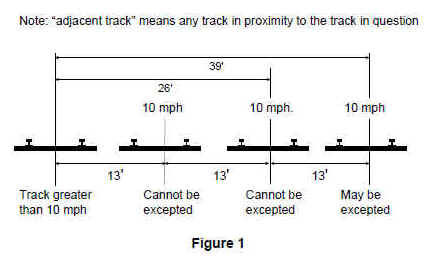
Operation on any track located within 30 feet of excepted track may be restricted to 10 mph by the physical layout of the tracks, or by definite restrictions placed by the track owner by rule, timetable, special instruction, or other positive instruction or order. These criteria provide the positive protection of trains on higher speed track against a collision with fouling equipment from a potential derailment on the excepted track.
The term "train" is defined in 49 CFR § 236.832 as, "A locomotive or more than one locomotive coupled, with or without cars". That definition applies to this rule.
A designation of excepted track need only be recorded by the track owner and implemented by issuance of appropriate instructions to all affected employees. The designation need not be filed with FRA. The TSS do not specify which employees the railroad or track owner must notify of excepted track designations; however, in order to ensure maximum safety and compliance with the requirements of this part, FRA recommends that railroad or track owner notify all employees who are involved with the operation of trains or with engineering functions on excepted track.
The identified segment is inspected in accordance with 213.233(c) and 213.235 at the frequency specified for Class 1 track;Guidance: § 213.5(b) provides that a railroad may continue train operations on track segments designated as excepted track without complying with Subparts B, C, D, and E of Part 213. However, a railroad must still comply with the inspection requirements contained in Subpart F for track segments designated as excepted track. Railroads must inspect excepted track in accordance with § 213.233(c) and 213.235 at the frequency specified for Class 1 track. Failure to comply will result in a violation and loss of the excepted track privilege until inspection requirements specified in this paragraph are met.
4(d) The identified segment of track is not located on a bridge including the track approaching the bridge for 100 feet on either side, or located on a public street or highway, if railroad cars containing commodities required to be placarded by the Hazardous Materials Regulations (49 CFR part 172), are moved over the track; and
Guidance:
In the application of this paragraph, a public street or highway is defined as a roadway that is open to the public and is owned and maintained by a public entity. This paragraph includes both crossings of public roadways at grade and longitudinal running of the track for extended distances in a public roadway (street trackage).Under § 214.7, a railroad bridge is defined as follows: 1) a railroad bridge is any structure supporting one or more railroad tracks with a span length of 12 feet or more measured along the track centerline; and 2) the term "bridge" shall apply to the entire structure between the faces of the backwalls of abutments or equivalent components, regardless of the number of spans. The term shall include all structures, whether of timber, stone, concrete, metal, or any combination thereof.
4(e) The railroad conducts operations on the identified segment under the following conditions:
(1) No train shall be operated at speeds in excess of 10 miles per hour;
(2) No occupied passenger train shall be operated;
(3) No freight train shall be operated that contains more than five cars required to be placarded by the Hazardous Materials Regulations (49 CFR part 172); and
(4) The gage on excepted track shall not be more than 4 feet 101⁄4 inches. This paragraph (e)(4) is applicable September 21, 1999.
Guidance: In reference to (e)(1) through (4), a well-documented pattern of repeated or widespread deviations from these requirements by a track owner, including train operations in excess of 10 mph, will effectively terminate the privilege afforded by this section. The affected track would then become subject to all requirements of the TSS.
The word ‘‘occupied’’ in (e)(2) refers to paying and non-paying passengers. It does not include train crew members, track maintenance crews, and other railroad employees who must travel over the track to attend to their work duties.
The gage requirement only applies to the actual measurement itself under load, and does not extend to the evaluation of crossties and fasteners that provide the gage restraint. In the case of noncompliance with the gage requirement in excepted track, the railroad may invoke § 213.9(b) as remedial action. [See § 213.9(b) for restrictions.]
4(f) A track owner shall advise the appropriate FRA Regional Office at least 10 days prior to removal of a segment of track from excepted status.
Guidance: The railroad or track owner is required to notify the appropriate FRA Regional Office 10 days before removing trackage from excepted status. A railroad may not move the track from excepted to non-excepted status to operate an occupied passenger train or a train containing more than five cars placarded in accordance with 49 CFR Part 172, unless proper notification procedures are followed.
Inspectors will continue to inspect excepted track and report these inspections on the F6180.96 form. If serious deficiencies are discovered, they will be shown on the inspection form, noting that the track is in excepted status. The railroad or track owner would not be legally obligated by the TSS to correct the deficiencies noted, except for gage deviations in excess of 4 feet 10¼ inches (213 defect code 0053B5). However, if the condition of the track continues to constitute a hazard to life and limb and the track owner fails to alleviate the hazard, the inspector should notify the regional track specialist immediately. Issuance of an emergency order would be appropriate to address any serious defects that would pose an immediate safety threat to railroad employees or the public.
This notification provision is intended to prevent the practice FRA has witnessed in the past by some railroads. Specifically, those who remove trackage from excepted status only long enough to move a passenger excursion train or a train with more than five cars containing hazardous materials.
The following examples are provided to inspectors to determine compliance with the provision of excepted track.
Example One. On January 15, 2014, a railroad designates a 2-mile segment of its yard track Number 1, which is Class 1 track, as excepted track. The excepted track segment is located within 25 feet of an adjacent track over which simultaneous operations at speeds up to 20 mph are authorized. On January 25, 2014, an inspector discovers five locations in that segment at which Class 1 gage requirements are not being met.
Result: The segment of yard track Number 1 involved is ineligible for designation as excepted track because it violates § 213.4(b) simultaneous use restriction. Therefore, the segment remains subject to provisions of the TSS for Class 1 track. FRA may cite for correction or violation any deviation from the TSS discovered in the segment, such as the five gage defects. The railroad may also be cited, at the FRA inspector’s discretion, for a violation of § 213.4(b) and will include the substantive defects (e.g., gage, alinement, crossties). As remedial action the railroad may authorize trains operations not to exceed 10mph speed restriction to include all tracks within 30-feet and adjacent to an excepted track, in effect removing the simultaneous use provision.
Example Two. A railroad designates yard track number 6, which is classified as Class 1 track, as excepted track on November 30, 2013. The railroad does not conduct any inspections over the track during December.
Result: Yard track number 6 loses its eligibility for designation as excepted track on January 1, 2014, and remains ineligible thereafter until the inspections required by
§ 213.4(c) begins. Starting January 1, 2014, the track becomes subject to all provisions of the TSS and remains subject to those requirements until such time as the inspections begin. Violation citations arising from inadvertent violations of the inspection requirement ordinarily should be issued only where safety was impaired or there is evidence of continued noncompliance.
In contrast to violations of the definitional (§ 213.4(a) to (d)) requirements, the unit of violation for noncompliance with the operational limitations is the train. We refer here to occasional and inadvertent noncompliance with operational limitations. A persistent and well-documented pattern of noncompliance with respect to a particular segment may cause the railroad to lose its privilege of designating the segment as excepted track (i.e., the track would no longer qualify for such designation), or force FRA to use more drastic enforcement remedies such as emergency orders. The following examples illustrate this concept.
Example Three. A railroad properly designates a track segment as excepted track, 10 days later it operates a freight train containing 10 placarded tank cars over the track segment.
Result: One violation of § 213.4(e)(3) by the railroad has occurred, not five, because the unit of violation is the train rather than each of the placarded cars exceeding the five car limit. The segment continues to be excepted track because a violation of an operational limitation does not render the track ineligible for excepted track status.
Example Four. Railroad A properly designates one of its track segments as excepted track. Railroad B’s freight train 2425, using the segment pursuant to a trackage rights agreement with Railroad A, operates over the segment at a speed of 20 mph.
Result: One violation has occurred of § 213.4(e)(2) by Railroad A. The track owner is the responsible party for illegal operations over the excepted track. The segment continues to be excepted track.
§ 213.5 Responsibility for compliance
5(a) Except as provided in paragraph (b) of this section, any owner of track to which this part applies who knows or has notice that the track does not comply with the requirements of this part, shall -
(1) Bring the track into compliance;
(2) Halt operations over that track; or
(3) Operate under authority of a person designated under § 213.7(a), who has at least one year of supervisory experience in railroad track maintenance, subject to conditions set forth in this part.
Guidance:
This paragraph describes the action that must be taken by a railroad or track owner once they know or have notice (knowledge standard) that the track is not in compliance with the TSS. The track owner must:(1) Bring the track into compliance by either repairing the defects or imposing an appropriate speed restriction.
(2) Remove the track from service, that is disallowing train operations.
(3) Operate under authority of a qualified person designated under § 213.7 in accordance with one the following provisions:
•
§ 213.9(b) Class of track–30-day provision.•
§ 213.11 Restoration or renewal of track under traffic conditions.•
§ 213.113 Rail defects.For additional information concerning the required corrective action for defects, see the guidance under § 213.9 (Classes of track; operating speed limit).
5(b) If an owner of track to which this part applies designates a segment of track as
”excepted track” under the provisions of § 213.4, operations may continue over that track without complying with the provisions of Subparts B, C, D, and E, unless otherwise expressly stated.Guidance. The owner may designate the track
”excepted” provided it meets the requirements of § 213.4.5(c) If an owner of track to which this part applies assigns responsibility for the track to another person (by lease or otherwise), written notification of the assignment shall be provided to the appropriate FRA Regional Office at least 30 days in advance of the assignment. The notification may be made by any party to that assignment, but shall be in writing and include the following --
(1) The name and address of the track owner;
(2) The name and address of the person to whom responsibility is assigned (assignee);
(3) A statement of the exact relationship between the track owner and the assignee;
(4) A precise identification of the track;
(5) A statement as to the competence and ability of the assignee to carry out the duties of the track owner under this part; and
(6) A statement signed by the assignee acknowledging the assignment to him of responsibility for purposes of compliance with this part.
Guidance: Paragraph 5(c) requires a track owner to notify FRA, through the appropriate regional office, when the responsibility for compliance with this part is assigned to another. Notification must contain the specific information required in this paragraph and shall be made 30 days before the assignment of the responsibility.
5(d) The Administrator may hold the track owner or the assignee or both responsible for compliance with this part and subject to penalties under 213.15.
Guidance:
Where the track is not owned by the operating railroad through an arrangement such as a lease agreement, typically the operating railroad will be cited for violations. However, it may be appropriate to recommend civil penalties against the operating railroad and the owner when both parties contributed to the deficiency. Inspectors must determine the responsible party when recommending civil penalties for noncompliance and alert FRA’s Chief Counsel when violation reports involve parties other than the track owner.This paragraph also provides that the party responsible for compliance can be other than the actual owner of the track through assignment of responsibility or if the Surface Transportation Board (formerly Interstate Commerce Commission) has issued a directed service order. FRA may hold responsible any party contracted by the track owner to ensure compliance with this part. FRA may hold the track owner, the assignee, or both responsible.
5(e) A common carrier by railroad which is directed by the Surface Transportation Board to provide service over the track of another railroad under 49 U.S.C. 11123 is considered the owner of that track for the purposes of the application of this part during the period the directed service order remains in effect.
Guidance: "on rare occasions, such as a cessation of service by a railroad, the Surface Transportation Board directs a railroad, other than the track owner, to provide service, the designated operator shall be considered as the owner for the purposes of compliance of the TSS.
5(f) When any person, including a contractor for a railroad or track owner, performs any function required by this part, that person is required to perform that function in accordance with this part.
Guidance: Both employees of railroads and track owners, and contractors to railroads, are subject to the requirements of the TSS when they perform functions required by the TSS.
§ 213.7 Designation of qualified persons to supervise certain renewals and inspect track
7(a) Each track owner to which this part applies shall designate qualified persons to supervise restorations and renewals of track under traffic conditions. Each person designated shall have—
(1) At least —
(i) 1 year of supervisory experience in railroad track maintenance; or
(ii) A combination of supervisory experience in track maintenance and training from a course in track maintenance or from a college level educational program related to track maintenance;
(2) Demonstrated to the owner that he or she—
(i) Knows and understands the requirements of this part that apply to the restoration and renewal of the track for which he or she is responsible;
(ii) Can detect deviations from those requirements; and
(iii) Can prescribe appropriate remedial action to correct or safely compensate for those deviations; and
(3) Written authorization from the track owner to prescribe remedial actions to correct or safely compensate for deviations from the requirements in this part.
7(b) Each track owner to which this part applies shall designate qualified persons to inspect track for defects. Each person designated shall have—
(1) At least—
(i) 1 year of experience in railroad track inspection; or
(ii) A combination of experience in track inspection and training from a course in track inspection or from a college level educational program related to track inspection;
(2) Demonstrated to the owner that he or she—
(i) Knows and understands the requirements of this part that apply to the inspection of the track for which he or she is responsible;
(ii) Can detect deviations from those requirements; and
(iii) Can prescribe appropriate remedial action to correct or safely compensate for those deviations; and
(3) Written authorization from the track owner to prescribe remedial actions to correct or safely compensate for deviations from the requirements of this part, pending review by a qualified person designated under paragraph (a) of this section.
Guidance
: Inspectors may request verification of the experience and qualifications of the supervisory and track inspection personnel from a track owner. The submission of a seniority roster or job awarding bulletin is not to be considered as satisfactory identification of qualified employees or as a basis for their designation. The owner should make specific names of individuals and their qualifications available in writing. If the inspector is in doubt as to the qualifications of the owner’s supervisory or inspection personnel, the inspector should examine the owner’s inspection records. The TSS require the retention of track inspection reports for 1 year. Should the records consistently fail to reflect the actual track conditions, questions can be raised as to the competence and/or qualifications of the persons included in the list.Paragraphs (a)(2)(i) and (b)(2)(i) clarify that the requirements for a person to be qualified under this section concern the portions of Part 213 necessary for the person to perform his/her duties. The person is not required to know or understand specific requirements of this part not necessary to fulfill his or her duties. For example, track foremen and inspectors may not be required to know or understand vehicle qualification and testing requirements for high cant deficiency operations in track Classes 1 to 5 in fulfilling their duties.
When in doubt as to the qualifications of an owner’s supervisors or inspectors, the inspector should discuss the matter with the railroad.
7(c) Individuals designated under paragraphs (a) or (b) of this section that inspect continuous welded rail (CWR) track or supervise the installation, adjustment, and maintenance of CWR track in accordance with the written procedures of the track owner shall have:
(1) Current qualifications under either paragraph (a) or (b) of this section;
(2) Successfully completed a comprehensive training course specifically developed for the application of written CWR procedures issued by the track owner;
(3) Demonstrated to the track owner that the individual:
(i) Knows and understands the requirements of those written CWR procedures;
(ii) Can detect deviations from those requirements; and
(iii) Can prescribe appropriate remedial action to correct or safely compensate for those deviations; and
(4) Written authorization from the track owner to prescribe remedial actions to correct or safely compensate for deviations from the requirements in those procedures and successfully completed a recorded examination on those procedures as part of the qualification process.
Guidance: As CWR track has characteristics inherently different than those of traditional jointed rail, track owners are required to designate which individuals are specifically qualified to inspect or supervise the installation, adjustment, and maintenance of CWR. In addition to the qualifications that an individual must have under either paragraph (a) or (b), an individual designated under paragraph (c) must have completed a CWR training course and be well-versed in the maintenance of CWR track as detailed in the track owner’s CWR plan. The comprehensive nature of the training course is more important than its duration; therefore, the railroad employee must successfully complete an indepth initial training course of the track owner’s written CWR procedures and continue subsequent periodic re-training thereafter, pursuant to the training program required by § 213.343(g). In addition, all individuals qualified on CWR for train operations must successfully complete a recorded examination on the track owner’s CWR procedures. This recorded examination may be, for example, a traditional written examination, an electronic file of a computerized interactive training course that concludes with an examination, or a record of a supervisor’s oral testing of the employee’s knowledge through practical field application. Due to the language of the regulation, track owners have flexibility to test an individual’s knowledge to one of the previously stated methods. However, it should be noted that the results of the examination must be recorded so that FRA may inspect the basis for the qualification of an individual under paragraph (c).
7(d) Persons not fully qualified to supervise certain renewals and inspect track as required in paragraphs (a) through (c) of this section, but with at least one year of maintenance-of-way or signal experience, may pass trains over broken rails and pull aparts provided that—
(1) The track owner determines the person to be qualified and, as part of doing so, trains, examines, and re-examines the person periodically within two years after each prior examination on the following topics as they relate to the safe passage of trains over broken rails or pull aparts: rail defect identification, crosstie condition, track surface and alinement, gage restraint, rail end mismatch, joint bars, and maximum distance between rail ends over which trains may be allowed to pass. The sole purpose of the examination is to ascertain the person's ability to effectively apply these requirements and the examination may not be used to disqualify the person from other duties. A minimum of four hours training is required for initial training;
(2) The person deems it safe and train speeds are limited to a maximum of 10 m.p.h. over the broken rail or pull apart;
(3) The person shall watch all movements over the broken rail or pull apart and be prepared to stop the train if necessary; and
(4) Person(s) fully qualified under § 213.7 are notified and dispatched to the location promptly for the purpose of authorizing movements and effecting temporary or permanent repairs.
Guidance
: Paragraph (d) allows employees to be qualified for the specific purpose of authorizing train movements over broken rails or pull-aparts. This section requires the employees to have at least 1 year of maintenance-of-way or signal experience and a minimum of 4 hours of training, plus an examination (and periodic re-examination within 2 years of each examination) on requirements related to the safe passage of trains over broken rails and pull-aparts. The purpose of the examination is to ascertain the person’s ability to effectively apply these requirements. A railroad may use the examination to determine whether a person should be allowed to authorize train movements over broken rails or pull-aparts.The maximum speed over broken rails and pull-aparts shall not exceed 10 mph. However, movement authorized by a person qualified under this subsection may further restrict speed, if warranted by the particular circumstances. The person qualified under this paragraph must
be present at the site and able to instantly communicate with the train crew so that the movement can be stopped immediately, if necessary.Fully qualified persons under § 213.7 must be notified and dispatched to the location promptly to assume responsibility for authorizing train movements and effecting repairs. The word "promptly" is meant to provide the railroad with flexibility to pass trains over the condition prior to the time the fully qualified person would report to the scene. Railroads may permit persons qualified under § 213.7(d) to authorize multiple train movements over such conditions, but the person qualified under § 213.7(d) must examine the broken rail or pull-apart area initially, and before each subsequent movement, to ensure the location is safe for the passage of the next train.
7(e) With respect to designations under paragraphs (a) through (d) of this section, each track owner shall maintain written records of—
(1) Each designation in effect;
(2) The basis for each designation; and
(3) Track inspections made by each designated qualified person as required by § 213.241. These records shall be kept available for inspection or copying by the Federal Railroad Administration during regular business hours.
Inspectors may request verification of the experience and qualifications of the supervisory and track inspection personnel from a track owner. The submission of a seniority roster or job awarding bulletin is not to be considered as satisfactory identification of qualified employees or as a basis for their designation. The owner should make specific names of individuals and their qualifications available in writing. If the inspector is in doubt as to the qualifications of the owner’s supervisory or inspection personnel, the inspector should examine the owner’s inspection records. The TSS require the retention of track inspection reports for 1 year at the owner’s division office. Should the records consistently fail to reflect the actual track conditions, questions can be raised as to the competence and/or qualifications of the persons included in the list.When in doubt as to the qualifications of an owner’s supervisors or inspectors, the inspector should discuss the matter with the railroad.
7(c) Individuals designated under paragraphs (a) or (b) of this section that inspect continuous welded rail (CWR) track or supervise the installation, adjustment, and maintenance of CWR track in accordance with the written procedures of the track owner shall have:
(1) Current qualifications under either paragraph (a) or (b) of this section;
(2) Successfully completed a comprehensive training course specifically developed for the application of written CWR procedures issued by the track owner;
(3) Demonstrated to the track owner that the individual:
(i) Knows and understands the requirements of those written CWR procedures;
(ii) Can detect deviations from those requirements; and
(iii) Can prescribe appropriate remedial action to correct or safely compensate for those deviations; and
(4) Written authorization from the track owner to prescribe remedial actions to correct or safely compensate for deviations from the requirements in those procedures and successfully completed a recorded examination on those procedures as part of the qualification process.
Guidance: As CWR track has characteristics inherently different than those of traditional jointed rail, track owners are required to designate which individuals are specifically qualified to inspect or supervise the installation, adjustment, and maintenance of CWR. In addition to the qualifications that an individual must have under either paragraph (a) or (b), an individual designated under paragraph (c) must have completed a CWR training course and be well-versed in the maintenance of CWR track as detailed in the track owner’s CWR plan. The comprehensive nature of the training course is more important than its duration; therefore, the railroad employee must successfully complete an indepth initial training course of the track owner’s written CWR procedures and continue subsequent periodic re-training thereafter, pursuant to the training program required by § 213.343(g). In addition, all individuals qualified on CWR for train operations must successfully complete a recorded examination on the track owner’s CWR procedures. This recorded examination may be, for example, a traditional written examination, an electronic file of a computerized interactive training course that concludes with an examination, or a record of a supervisor’s oral testing of the employee’s knowledge through practical field application. Due to the language of the regulation, track owners have flexibility to test an individual’s knowledge to one of the previously stated methods. However, it should be noted that the results of the examination must be recorded so that FRA may inspect the basis for the qualification of an individual under paragraph (c).
7(d) Persons not fully qualified to supervise certain renewals and inspect track as required in paragraphs (a) through (c) of this section, but with at least one year of maintenance-of-way or signal experience, may pass trains over broken rails and pull aparts provided that—
(1) The track owner determines the person to be qualified and, as part of doing so, trains, examines, and re-examines the person periodically within two years after each prior examination on the following topics as they relate to the safe passage of trains over broken rails or pull aparts: rail defect identification, crosstie condition, track surface and alinement, gage restraint, rail end mismatch, joint bars, and maximum distance between rail ends over which trains may be allowed to pass. The sole purpose of the examination is to ascertain the person's ability to effectively apply these requirements and the examination may not be used to disqualify the person from other duties. A minimum of four hours training is required for initial training;
(2) The person deems it safe and train speeds are limited to a maximum of 10 m.p.h. over the broken rail or pull apart;
(3) The person shall watch all movements over the broken rail or pull apart and be prepared to stop the train if necessary; and
(4) Person(s) fully qualified under § 213.7 are notified and dispatched to the location promptly for the purpose of authorizing movements and effecting temporary or permanent repairs.
Guidance: Paragraph (d) allows employees to be qualified for the specific purpose of authorizing train movements over broken rails or pull-aparts. This section requires the employees to have at least 1 year of maintenance-of-way or signal experience and a minimum of 4 hours of training, plus an examination (and periodic re-examination within 2 years of each examination) on requirements related to the safe passage of trains over broken rails and pull-aparts. The purpose of the examination is to ascertain the person’s ability to effectively apply these requirements. A railroad may use the examination to determine whether a person should be allowed to authorize train movements over broken rails or pull-aparts.
The maximum speed over broken rails and pull-aparts shall not exceed 10 mph. However, movement authorized by a person qualified under this subsection may further restrict speed, if warranted by the particular circumstances. The person qualified under this paragraph must be present at the site and able to instantly communicate with the train crew so that the movement can be stopped immediately, if necessary.
Fully qualified persons under § 213.7 must be notified and dispatched to the location promptly to assume responsibility for authorizing train movements and effecting repairs. The word “promptly” is meant to provide the railroad with flexibility to pass trains over the condition prior to the time the fully qualified person would report to the scene. Railroads may permit persons qualified under § 213.7(d) to authorize multiple train movements over such conditions, but the person qualified under § 213.7(d) must examine the broken rail or pull-apart area initially, and before each subsequent movement, to ensure the location is safe for the passage of the next train.
7(e) With respect to designations under paragraphs (a) through (d) of this section, each track owner shall maintain written records of—
(1) Each designation in effect;
(2) The basis for each designation; and
(3) Track inspections made by each designated qualified person as required by § 213.241. These records shall be kept available for inspection or copying by the Federal Railroad Administration during regular business hours.
[63 FR 34029, June 22, 1998, as amended at 74 FR 43002, Aug. 25, 2009; 78 FR 16100, Mar. 13, 2013]
Guidance: Failure of the owner to have and maintain written records designating employees and the basis for each designation is a deviation from the TSS. Incomplete qualification records would also constitute a deviation from the standards. Designated employees include supervisors, inspectors, and those partially qualified to pass trains over broken rails and pull-aparts. Inspectors are also instructed to note that incomplete qualification records may not reflect the actual qualification of an individual. As such, a record deficiency shall not be the sole basis for a defect or civil penalty recommendation for not having a qualified designated person performing these functions. If there are questions about the qualifications of an individual, it will be necessary for the inspector to interview railroad or contractor employees.
§ 213.9 Classes of track: operating speed limits
9(a) Except as provided in paragraph (b) of this section and
'213.57(b), 213.59(a), 213.113(a), and 213.137(b) and (c), the following maximum allowable operating speeds apply: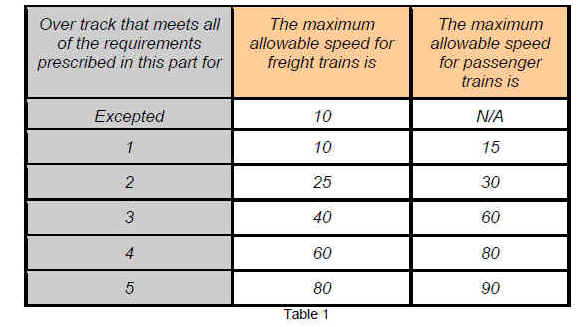
Guidance: The TSS classifies track solely on the basis of authorized speeds for freight and passenger trains. Tolerances are specified in the TSS for each class of track. A deviation beyond the limiting tolerances for Classes 1 through 5 requires repair, or reduction of speeds to the appropriate class. The only structural or geometry defect that is applicable on excepted track is gage exceeding 4 feet 10¼ inches.
The initial speed of any track is based on the design characteristics of the track. FRA does not set the speed, and railroads are required to keep track in compliance with the requirements of Part 213. In addition to track design characteristics, speeds may be set by other factors such as the type of signal apparatus. Maximum speeds are also limited if a signal system is not in place on a track (refer to 49 CFR § 236 for further information).
If a deviation exceeds Class 1 standards, operations may continue for not more than 30 days over the deviation, not exceeding Class 1 speeds. This is only permitted after a person designated and qualified in the provisions of § 213.7(a), determines that operations may safely continue and specifies limiting conditions, if any. The designated person must have personally seen and evaluated the deviation. This section may also govern a deviation exceeding allowable gage on excepted track.
As described in paragraph (a), the maximum allowable operating speed for each class of track is shown in the table. However, the maximum allowable operating speed on a curve is also limited by the geometry parameters contained in § 213.57(b) [Unbalance] and § 213.59(a) [Superelevation]. For example, a speed for a passenger train based on the elevation at a curve may be only 18 mph, even though the track may otherwise comply with a higher track class.
The rule is to provide a railroad or track
owner additional flexibility in resolving defective conditions while continuing rail service over the track. One loose frog bolt, out of several, would seldom constitute an immediate hazard, provided that the frog was otherwise secure. On the other hand, a missing cotter pin in a critical location such as in a connecting rod could have serious consequences.One or two loose braces are usually not considered to be an immediate hazard, provided that the other braces are in acceptable functional condition to support the stock rail. On the other hand, several consecutively loose braces, especially in the higher track classes, could be much more serious.
Intermittent patches of vegetation that brush the sides of rolling stock may not be an immediate hazard, but more severe vegetation might have the potential of contributing to the injury of an employee who is riding on the side of a car or looking out locomotive cab windows. The specific description for this type of defect is "vegetation brushing sides of rolling stock that prevents employees from visually inspecting moving equipment from their normal duty stations" (213 defect code 0037E3).
As the above examples illustrate, non-class-specific defects (not associated with a particular track classification) must be considered in the context of the specific circumstances involved. The existence of a non-class-specific defect under one set of circumstances may not be serious, while the identical condition under other circumstances may constitute a serious safety concern.
Although some non-class-specific defects may not present an immediate hazard, these conditions will only degrade under train traffic. Therefore, it is important for the railroad or track owner and FRA inspectors to record these defects for remedial or corrective action. In summary:
1. Record all noncomplying conditions, including non-class-specific defects such as loose or missing frog bolts or switch braces. Care must be taken to conduct a thorough inspection, recording the location, type, and size of each defect discovered.
2. Evaluate the remedial action taken by the carrier. If an inspector becomes aware that the remedial action, or lack thereof, for a non-class-specific defect is not sufficient based on the circumstances, the inspector should seek a more appropriate action from the carrier. For a non-class-specific defect that is an imminent hazard, such as a missing nut on a connecting rod, the inspector should immediately inquire as to the remedial action planned by the carrier.
3. If the railroad does not initiate an appropriate remedial action, the inspector should consider recommending a violation. If the railroad has been advised that a violation has been recommended and has not initiated appropriate remedial action, the inspector should be prepared to issue a Special Notice for Repairs, under the guidelines described in Chapter 4 of this manual.
4. In the case of a non-class-specific defect that did not pose an immediate hazard when the defect was recorded and the inspector discovers that no action was taken within a reasonable time frame after the carrier had knowledge of the defect, the inspector should consider the enforcement options described in item 3 above. In any case, if no appropriate action was taken within a 30-day period, the inspector should consider the enforcement tools outlined above.
When a railroad inspector discovers a non-class-specific defect (as with all defects) the railroad inspector must initiate immediate action in accordance with § 213.233(d). The remedial action taken by the railroad inspector must be recorded in accordance with § 213.241(b). For non-class-specific defects, the record must show a reasonable explanation of the action taken. For example, "repaired before next train" would be appropriate for serious conditions. On the other hand, a notation for a defect such as vegetation that indicates it is scheduled for cutting by a weed mower by a specific date within 30-days may be appropriate.
When a railroad representative places a slow order on a segment of track for a defect for immediate corrective action, any other items within the same slow order segment would be "protected". For example, an FRA inspector finds a defect at Milepost (MP) 5.5 and railroad immediately places a slow order from MP 5.0 to MP 6.0. During the same inspection, the FRA inspector also finds a condition at MP 5.8 that would be a defect without the speed restriction. While the defect at MP 5.8 is under the slow order just imposed, it was obviously a defect prior to the placement of the temporary restriction. The FRA inspector can record a defect at MP 5.8.
A non-class-specific defect may not pose an immediate hazard for one train movement, but the condition may deteriorate to become a hazard to following trains. It is reasonable to expect that conditions such as loose or missing frog bolts or braces be repaired as quickly as possible. However, a qualified railroad representative under § 213.7 may determine that the condition is not an immediate hazard and decide to call for assistance to make the repairs, or the representative may decide to end the inspection, retrieve the necessary repair materials, and return later to make the repairs. In some cases, the representative may determine that a speed restriction is appropriate.
When non-class-specific defects are scheduled for repair, railroad inspectors shall continue to report the defect on their inspection reports until it is corrected. However, the 30-day limit for any given defective condition cannot be exceeded.
9(b) If a segment of track does not meet all of the requirements for its intended class, it is reclassified to the next lowest class of track for which it does meet all of the requirements of this part. However, if the segment of track does not at least meet the requirements for Class 1 track, operations may continue at Class 1 speeds for a period of not more than 30-days without bringing the track into compliance, under the authority of a person designated under § 213.7(a),
who has at least one year of supervisory experience in railroad track maintenance, after that person determines that operations may safely continue and subject to any limiting conditions specified by such person.Guidance: A track segment must meet all the requirements for its designated class. Where a track segment does not meet all the requirements, railroads can reclassify the segment for the next lowest class for which it complies. For example, on a Class 3 Track, where the alinement mid-chord offset from a 62-foot chord on a tangent track measured 2-inches, the railroad can elect to reduce the speed equivalent to Class 2 track.
Trains may continue to operate over a noncomplying condition under § 213.9(b). However, the 30-day limit for any given condition cannot be exceeded. The 30-day period commences when:
• An FRA inspector notifies the carrier or issues notice with a F6180.96 form.
• A person designated under § 213.7 records the defect on a track owner’s record of inspection.
• Notices of substandard conditions are received from third parties.
• The track owner is deemed to have constructive knowledge if the defects were discoverable through properly performed track inspections required by the TSS, even if the defects are not reported on the owner’s record of inspection.
Several other points concerning § 213.9(b) should be noted:
• FRA inspectors should not attempt to predict an exact date on which a sub-Class 1 defect first existed. In most cases, a reasoned approximation (with accompanying explanation of the basis for the inspector’s conclusions) will be sufficient to show that § 213.9(b) is not available to the track owner. Because of the serious enforcement problems presented by application of the constructive knowledge test, inspectors should use this authority judiciously.
• Once a determination has been made that operations may safely continue over a segment, the 30-day period applies to all sub-Class 1 defects present in the segment at that time. The 30-day period is an appropriate remedial action for sub-Class 1 defects and the 30-day period can only be applied one time. At the expiration of the 30-day period, the defects must be repaired, track placed into excepted track status, or the track must be removed from service.
• The limiting conditions, if any, placed on operations must be in a form generally used by the track owner to communicate operating restrictions to its personnel and to any other railroads authorized to use the track involved. If a train operating over the track fails to comply with any such condition, one violation of § 213.9(b) by the track owner has occurred, regardless of the identity of the operator of the train.
• Section 213.9(b) does not apply where defective rails are involved. Section 213.113 exclusively governs further operations over defective rails.
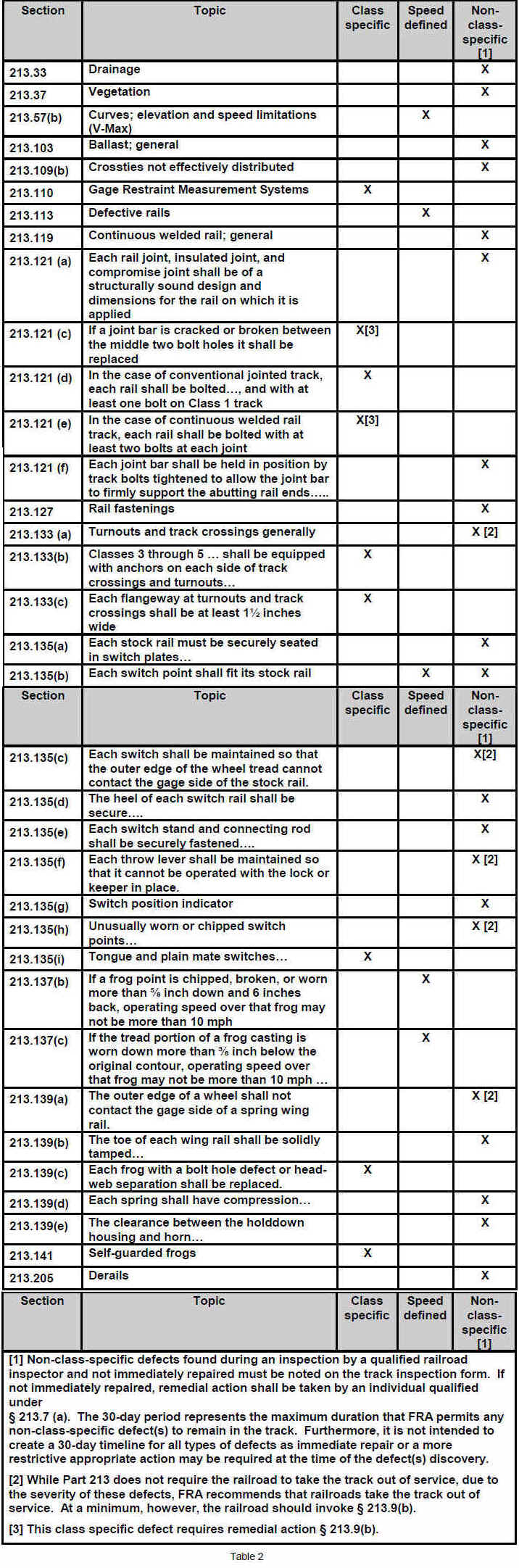
The following table shows examples of those sections in the TSS that are "class specific," "speed defined" and "non-class-specific." This table is not all-inclusive and is only a reference instrument. Inspectors should refer to the specific guidance under each section for further details and instructions on each item listed in the table.

§ 213.11 Restoration or renewal of track under traffic conditions
If, during a period of restoration or renewal, track is under traffic conditions and does not meet all of the requirements prescribed in this part, the work on the track shall be under the continuous supervision of a person designated under §213.7(a) who has at least one year of supervisory experience in railroad track maintenance, and subject to any limiting conditions specified by such a person. The term “continuous supervision” as used in this section means the physical presence of that person at a job site. However, since the work may be performed over a large area, it is not necessary that each phase of the work be done under the visual supervision of that person.
Guidance: This section specifies that a person designated under § 213.7(a) must provide continuous supervision during work periods when track with conditions not complying with the designated class is under traffic conditions. The section is specific in that each phase of the restoration or renewal need not be under the visual supervision of that person, but the person must be present at the job site in direct control of the work and have direct knowledge of the condition of the track over which they permit a train or trains to pass.
The qualified person at a work site may determine that it is safe to permit a train to pass through the work area at any speed up to the permanent speed on the track. For example, during a crosstie and resurfacing project, the qualified person may analyze the conditions present and authorize a speed higher than 10 mph through the limits of the work when temporary crosslevel conditions exceed the limits in § 213.63 for Class 1 track. Similarly, a welder may permit a train to pass over a frog when the welding and grinding process temporarily removes the point more than 6 inches back and ⅝-inch down. At the end of the work period, when the designated person leaves the work site, the track must be in compliance with the TSS. It is acceptable for the designated person to determine that the track is safe for operation at Class 1 speeds and use § 213.9(b) as a remedial action.
Continuous supervision may be met if the work is broken into a number of segments over a large area. Inspectors must use judgment and experience in applying this limitation to the general rule. The essential questions are whether the specific circumstances of a given project actually permit effective supervision by the designated person, and whether such supervision is being properly exercised. An example of an acceptable application of this paragraph would be a large tie and surfacing unit that has cleared a track for a short period to allow the passage of a train based on the qualified person determining that the track is safe for operation. On the other hand, if a switch gang is working separately from the tie and surfacing crew in the same general vicinity, a qualified person must be with that work unit.
§ 213.13 Measuring track not under load
When unloaded track is measured to determine compliance with
requirements of this part, the amount of rail movement, if any, that occurs
while the track is loaded must be added to the measurements of the unloaded
track.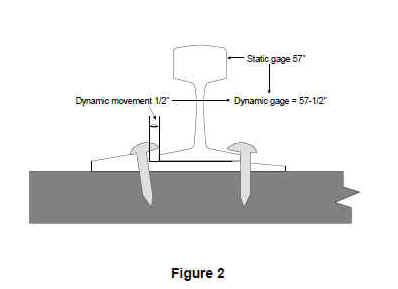
Guidance. In addition to the static (unloaded) geometry measurements taken, the amount of visually detectable dynamic (loaded) deflection that occurs under train movement must be considered. This includes the amount of vertical or lateral rail deflection occurring between a rail base and a tie plate or a tie plate and a crosstie; from voids between the crosstie and ballast section resulting from elastic compression; or any combinations of the above. Each deflection under the running rails must be measured and properly considered when computing the collective deviations under load. It is very important that consideration be given to both rails when measuring these deflections.
Vertical and lateral deflections may be found at locations such as rail joints and turnout locations with poor wooden crossties and conventional cut-spike fastening conditions or at bridge abutments and over culverts where the subgrade has settled.

§213.14 Application of requirements to curved track.
Unless otherwise provided in this part, requirements specified for curved track apply only to track having a curvature greater than 0.25 degree.
Guidance: The section defines what is meant by curved track for the purpose of application of application of requirements for curved track. Unless otherwise provided in this part, requirements specified for curved track apply only to track having a curvature greater than 0.25 degree. This definition is intended to apply in all sections where limits for curved track are specified, unless otherwise provided.
Please note that, by implication of this section, track measurement systems required for compliance with part 213 must be able to detect curves with this minimum specified degree of curvature.
§ 213.15 Penalties
15(a) Any person who violates any requirement of this part or causes the violation of any such requirement is subject to a civil penalty of at least $500 and not more than $11,000 per violation, except that: Penalties may be assessed against individuals only for willful violations, and, where a grossly negligent violation or a pattern of repeated violations has created an imminent hazard of death or injury to persons, or has caused death or injury, a penalty not to exceed $22,000 per violation may be assessed. “Person” means an entity of any type covered under 1 U.S.C. 1, including but not limited to the following: a railroad; a manager, supervisor, official, or other employee or agent of a railroad; any owner, manufacturer, lessor, or lessee of railroad equipment, track, or facilities; any independent contractor providing goods or services to a railroad; any employee of such owner, manufacturer, lessor, lessee, or independent contractor; and anyone held by the Federal Railroad Administrator to be responsible under §213.5(d) or §213.303(c). Each day a violation continues shall constitute a separate offense. See Appendix B to this part for a statement of agency civil penalty policy.
(b) Any person who knowingly and willfully falsifies a record or report required by this Part may be subject to criminal penalties under 49 U.S.C. 21311.
Guidance. This section covers all subparts of Part 213, including a schedule of civil penalties found under Appendix B of this manual.
§ 213.17 Waivers
17(a) Any owner of track to which this part applies, or other person subject to this part, may petition the Federal Railroad Administrator for a waiver from any or all requirements prescribed in this part. The filing of such a petition does not affect that person’s responsibility for compliance with that requirement while the petition is being considered.
Guidance. Inspectors have no authority under the TSS to grant waivers.
17(b) Each petition for a waiver under this section must be filed in the manner and contain the information required by Part 211 of this Chapter.
Guidance: Per 49 CFR 211.7(b) and 211.45(f), any petition for waiver must be filed by the owner or designated operator with the Docket Clerk, Office of Chief Counsel, in Washington, D.C. The petition can also be filed by a trade association, such as Association of American Railroads (AAR), on behalf of its members. In addition to this chapter, inspectors should also reference the FRA Office of Railroad Safety’s General Manual, Chapter 5 Complaint and Waiver Investigations, for guidance and information regarding waiver procedures.
General Manual, Chapter 5 (page 153) indicates that waiver petitions may also be addressed to a FRA manager or specialist. In the past, most petitions have been addressed to the chairperson of the FRA Railroad Safety Board as most waivers are decided by the board.
17(c) If the Administrator finds that a waiver is in the public interest and is consistent with railroad safety, the Administrator may grant the exemption subject to any conditions the Administrator deems necessary. Where a waiver is granted, the Administrator publishes a notice containing the reasons for granting the waiver.
Guidance:
Typically, waivers bear the signature of AA/Chief Safety Officer, or his/her delegate. Inspectors should keep updated with any waivers in effect in their assigned territory which are relevant to their job activities.§213.19 Information collection
19(a) The information collection requirements of this part were reviewed by the Office of Management and Budget pursuant to the Paperwork Reduction Act of 1980 (44 U.S.C. 3501 et seq.) and are assigned OMB control number 2130-0010.
19(b) The information collection requirements are found in the following sections: 213.4, 213.5, 213.7, 213.57, 213.119, 213.122, 213.233, 213.237, 213.241, 213.303, 213.305, 213.317, 213.329, 213.333, 213.339, 213.341, 213.343, 213.345, 213.353, 213.361, 213.369.
- ARC-Tech.Net internet websites
- ww.railroadtraining.net
- Source Study Manual and Rules Book information provided by the Federal Railroad Administration.
- Presentation Copyright © 2007-2018 ARC-Tech.Net. All rights reserved.